The Creator Economy Has an Infrastructure Problem
Creators have more ways to earn than ever. The systems they use to manage those businesses haven’t necessarily kept up.

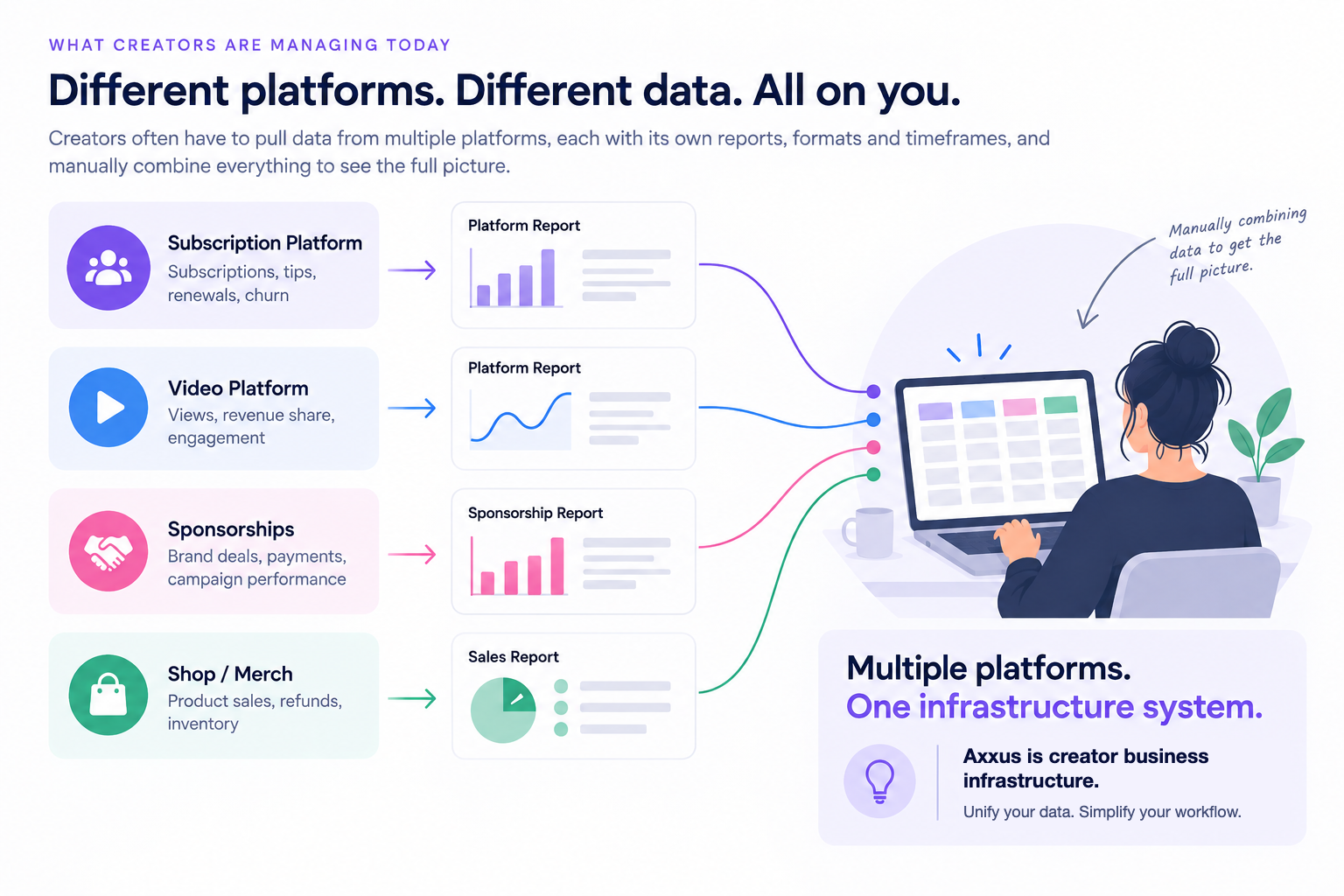
A creator who earns from four places has four sets of numbers. The subscription platform reports subscribers and renewals. The video platform reports views and estimated revenue. Sponsorships arrive as invoices. The shop reports orders. None of them use the same definitions, and none show what the others earn.
Creators have more ways to earn than ever, and the systems for running those businesses have not kept pace. Axxus is creator business infrastructure, built to help creators manage that side of the business with greater clarity.
The scale of the market
Estimates of the creator economy vary widely, and definitions differ. One frequently cited reference point is a 2023 analysis by Goldman Sachs Research. It projected that the creator economy’s total addressable market could roughly double from about $250 billion to $480 billion by 2027, and estimated about 50 million global creators. The same analysis estimated that only about 4% of creators are professionals earning more than $100,000 a year.
These figures are a projection and an estimate from 2023, not measurements. They indicate scale and shape more than precise numbers: a large population of creators running businesses of very different sizes, with a small share earning at a professional level.
What creators are managing today
Each platform measures its own world. A “subscriber,” a “member” and a “follower” are three different relationships with different economics, reported in different formats at different intervals. Options for exporting data vary from one service to the next.
Analysis: comparing performance across platforms means exporting, copying and reconciling by hand, usually in a spreadsheet. That work competes with making the content.
Multiple revenue streams
Diversifying income is widely recommended, and the reasoning is covered in Attention Isn’t Income. It has an operational cost. Each stream comes with its own fees, payout timing, currency and tax treatment. Money arrives on different dates for work done at different times. Turning that into a clear picture of profit, and not only revenue, takes deliberate effort.
A single view of the business becomes more useful as income diversifies. Platforms have little reason to provide one, because they do not show creators what they earn elsewhere.
Content across platforms
One idea can become a long video, several short clips, a newsletter, a set of images, a preview for a paid space and a link on a storefront. Each version needs formatting, scheduling, tracking and storage. Rights and permissions add to the load. Many creators manage this with folders and notes apps.
Fan relationships
On most platforms, the relationship with the audience lives on the platform. The creator can usually reach people through the service’s tools, and often cannot take the audience elsewhere if the service changes, restricts the account or closes it. A direct channel such as an email list reduces that risk. Keeping it current, and knowing which fans are the same person across services, is additional work.
Business administration
Every creator business has the ordinary requirements of a small company: invoices, contracts, expenses, records, tax preparation and, in some cases, staff or freelancers. In many countries creators are treated as self-employed, so these duties fall on them directly. Because the creative work is the visible part, administration is often left until a tax deadline or a dispute forces the issue.
What this looks like in practice
This is an illustration, not data. At month-end, the creator from the opening exports figures from the subscription platform, copies earnings from the video platform’s report, checks email for sponsorship invoices, pulls sales from the shop and adds up what reached the bank account. Then they set aside money for tax, note which expenses to claim and work out which source is growing. Each step is routine. Together they take hours every month and are easy to get slightly wrong.
Privacy
For many creators, privacy is a working requirement, not a preference. They may operate under a pseudonym, keep identities separate and manage the verification information that platforms require. Public, platform and legal identities are different layers, as explained in How Private Can You Actually Be as a Creator?, and keeping them apart takes deliberate work.
Opinion: most business tools are designed as if everyone works under their real name. Tools that assume otherwise, and treat a creator’s identity information carefully, are uncommon.
Platform dependence
Creators depend on platforms whose rules, fees and policies they do not control. This follows from how the market works and is not specific to any one service. A comparison of creator platform models shows how it plays out in each. The effect on infrastructure is that creators have to build their own management layer on top of systems that were not designed to be managed together.
Why the gap persists
Analysis: each platform is focused on its own product and has little incentive to help creators compare it with a competitor. Tools that work across platforms depend on the data each service chooses to expose, and that access can change. The creator market is also varied, from hobbyists to full-time businesses with staff, and general-purpose tools rarely fit needs such as multi-platform revenue, pseudonymous operation and irregular income. Individual creators fill the gap with their own time.
AI and automation
AI tools are increasingly proposed for this workload: organising data, summarising performance, scheduling and routine administration. Analysis: they are most useful where the task is repetitive and the result can be checked.
Some conditions apply:
- Financial and performance figures need to be accurate and traceable, because a wrong number stated confidently is worse than none.
- Business data and identity information are sensitive, so how a tool stores and uses them matters.
A reasonable standard is that the creator can see how an answer was produced and can override it.
What better infrastructure would need to do
Opinion, not an established standard. Infrastructure that fits how creators work would probably:
- Give a single view of the business, bringing platform data, revenue and costs together without manual rebuilding.
- Keep the creator in control of their data and make it portable.
- Work for the full range of creators, including pseudonymous, faceless and multi-platform businesses, and treat identity information with care.
- Show its working. Where technology automates or recommends, the reasoning and the source data should be visible.
- Keep humans available, because some questions need a person who understands the business.
Where Axxus fits
Axxus is creator business infrastructure built to help creators start, grow, and manage their businesses with greater clarity. It combines intelligent technology, performance insights, practical tools and optional hands-on support, and works on the problems described above.
Nothing in this article is a claim about outcomes for any individual creator. Earnings depend on many things that infrastructure cannot change. There is no fixed ceiling on what a creator business can grow to.
Sources and notes
- Goldman Sachs Research, “The creator economy could approach half-a-trillion dollars by 2027,” Eric Sheridan, 19 April 2023. Figures cited: projected growth from about $250 billion to $480 billion by 2027; about 50 million global creators; about 4% of creators earning more than $100,000 a year. These are estimates and projections.
- Descriptions of platform data and administration are editorial analysis, not measured data.
Axxus is creator business infrastructure built to help creators start, grow, and manage their businesses with greater clarity. Learn more at axxus.io.