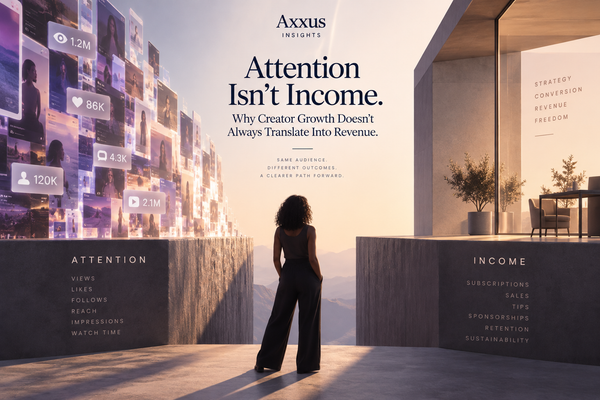
OnlyFans, SextPanther and Beyond: Creator Platforms Don’t All Monetize Attention the Same Way
Subscriptions, paid messages, tips, ads and owned channels each turn attention into income in a different way. A neutral comparison of the models, with no winner declared.
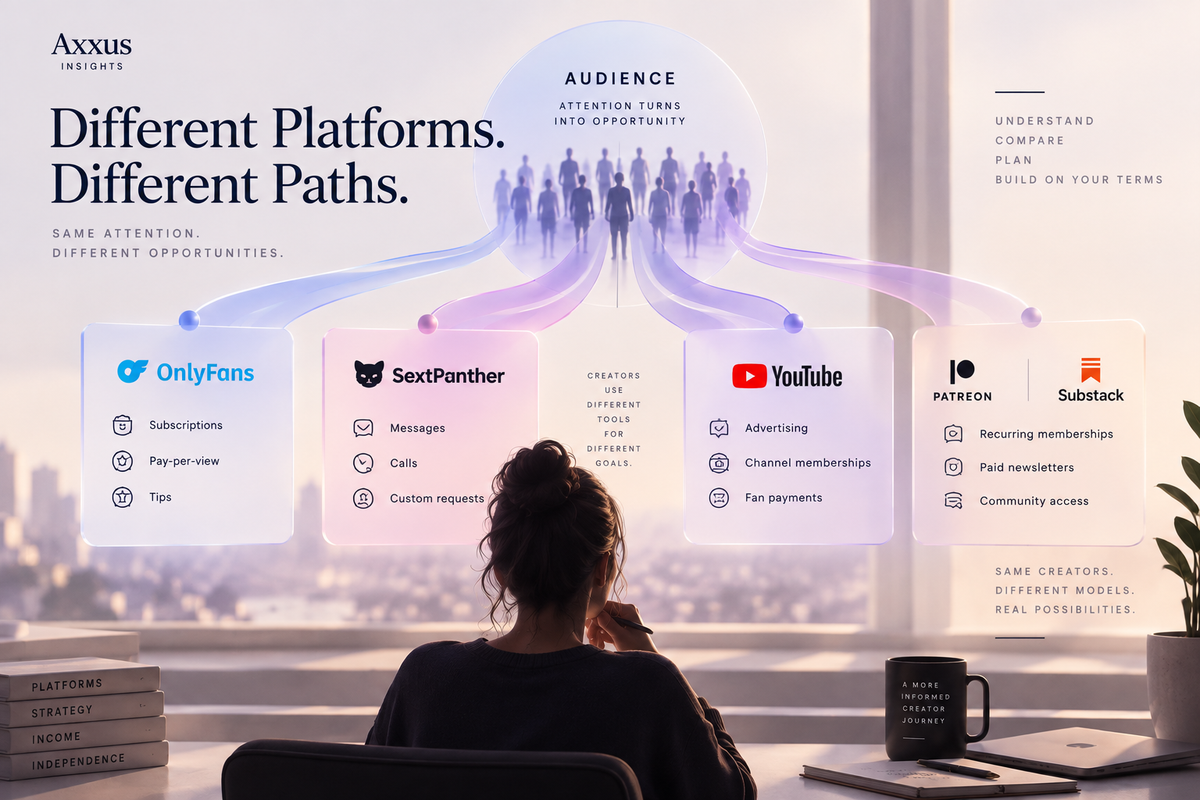
Two creators can each have 50,000 people who like their work and end up running very different businesses. The difference often has less to do with talent or effort than with the platform they chose, because each platform has its own answer to a basic question: how does attention get paid for?
OnlyFans and SextPanther are two platforms creators frequently ask about, and each answers that question differently, as do the options beyond them. No platform is ranked or recommended. Platform terms, fees and features change often, so anything described should be checked against the platform’s current terms before you rely on it.
Five ways platforms turn attention into payment
A monetization model is the mechanism by which a platform lets audiences pay creators, or lets creators earn from an audience. Most platforms combine several, but each tends to lean on one. Five are worth knowing:
- Recurring access. A fan pays a repeating fee to reach a creator’s content or community.
- Per-interaction payment. A fan pays for individual exchanges, such as a message, a call or a request.
- Per-item payment. A fan pays to unlock or buy a specific piece of content.
- Voluntary payment. Tips, gifts or donations, where the fan chooses the amount.
- Indirect income. Advertising revenue shares, sponsorships and affiliate links, where the payer is not the fan.
The model shapes almost everything else: how income behaves month to month, how much of a creator’s time it consumes, how new fans find them, and what happens if the rules change.
Subscription-led platforms: OnlyFans as an example
OnlyFans is generally described as a subscription-led platform. A creator sets a price for access to their page, and fans pay to subscribe. On top of that, creators can typically add tips, paid messages and pay-per-view posts, so the platform blends recurring access with per-item and voluntary payments. The platform keeps a share of what creators earn. Variety reported in August 2026 that the platform takes a 20% commission on gross revenue.
What this means in practice, as analysis rather than fact about any one creator:
- Income shape. A recurring base plus variable extras. Retention, meaning how long subscribers stay, is usually the number that matters most.
- Discovery. Platforms of this kind are generally not built primarily around recommending new creators to strangers, so many creators bring their own audience from elsewhere.
- Fan relationship. Ongoing and relatively stable, because a subscription is a standing commitment.
- Workload. Regular content production, plus messaging and community upkeep.
Interaction-led platforms: SextPanther as an example
SextPanther approaches the same audience from a different direction. Its site describes fans exchanging direct messages, picture, video and voice messages, and calls with creators, in one-to-one conversations. The unit of payment is closer to the interaction than to the subscription.
SextPanther’s public pages do not state platform fees, payout terms or verification requirements for creators.
The likely implications, again as analysis:
- Income shape. More closely tied to time and responsiveness than to audience size. Income tends to scale with the hours a creator spends interacting.
- Discovery. Fans usually come looking for a specific person or a specific kind of interaction.
- Fan relationship. Personal and direct, which some creators value and others find hard to sustain.
- Workload. Real-time availability matters, so schedule and boundaries carry more weight.
Beyond these two
These are not the only models, and many creators use several at once.
Advertising and membership on social and video platforms
On platforms such as YouTube, income can come from a share of advertising revenue, channel memberships and viewer payments, once a channel meets the platform’s eligibility rules. Discovery is the platform’s strength. Control is its weakness, because distribution and eligibility are decided by the platform.
Subscription publishing and patronage
Tools for writers, podcasters and artists, such as Substack and Patreon, focus on recurring support for ongoing work. They resemble the subscription-led model above, applied to other kinds of creators.
AI and automation
AI tools are increasingly used for editing, drafting, scheduling and organising a creator’s work. Platforms are also developing rules on AI-generated content including how it should be labelled, and those rules differ from one service to the next and continue to change. For creators, the practical question is which uses of AI a given platform permits.
Comparing the models without ranking them
The trade-offs, side by side. None of them points to a winner.
- Recurring access (subscription-led): the fan pays for ongoing access; the creator or platform sets the price; income is steadier if retention is good; the main dependency is the platform’s rules and payment partners.
- Per-interaction (interaction-led): the fan pays for individual exchanges; the creator often sets rates within the platform’s framework; income follows hours worked; the main dependency is the platform’s rules plus the creator’s own capacity.
- Indirect (advertising and sponsorship): the payer is an advertiser or brand; income follows reach and eligibility; the main dependency is the platform’s distribution and monetization rules.
- Owned channels: the fan pays you directly; you set the terms; income grows slowly; the main dependency is your own operations.
Discovery is not the same as relationship
It helps to separate two jobs a platform can do. One is discovery, putting a creator in front of people who have not met them. The other is relationship, giving a creator and a fan a place to build an ongoing connection and a way to pay. Some platforms are strong at the first and light on the second. Others are the reverse. A creator who understands which job a platform does can use each for what it is good at, for example by finding an audience in one place and serving it in another. That is analysis, not a rule, but it explains why so many creators end up using more than one service.
What all of them share: dependence on someone else’s rules
Whatever the model, most creator platforms depend on payment processors, banks and card networks, and on their own policies, both of which the creator does not control.
A widely reported example: in August 2021, OnlyFans announced that it would stop allowing sexually explicit content from October, then reversed that decision within about a week, saying it had secured the assurances it needed from its banking partners. Whatever one makes of the specifics, the episode shows how a creator’s income can hinge on decisions made far away from them and with little notice.
This is the practical meaning of platform dependence, and it applies to every model above. It is one reason to consider revenue concentration before choosing where to build.
Reading a platform’s terms
Most of what matters for a creator’s business sits in documents few people read closely: the terms of service, the creator or payments agreement, the fee schedule and the privacy policy. When you read them, look for the fee and how it is calculated, the payout schedule and minimum, what happens to unpaid balances if an account is restricted, the identity and tax information required, the rules on content and on AI-generated material, and the appeal process. Write down the date you read each document and keep a copy, because terms are updated and the version you agreed to may not be the version in force next year.
Questions to ask about any platform
- Who pays whom, and what exactly is the fan paying for?
- What share does the platform keep, and are there other fees?
- When and how are creators paid, and are there minimum payout amounts?
- What identity, tax and banking information is required, and how is it stored? (See How Private Can You Actually Be as a Creator?)
- How do new fans discover creators, if at all?
- What can the platform do to my account, and what is the appeal process?
- Can I export my audience or contact details?
- What are the rules on AI-generated content and on content protection?
- How much of my income would depend on this one platform?
There is no best platform
A neutral comparison leads to one conclusion: the right platform depends on the creator. It depends on how visible you want to be, how you prefer to work, how large your existing audience is, how much time you can give and what boundaries you hold. If you are earlier in the process, the guide for people considering creator work is a better place to begin.
Sources and notes
- OnlyFans commission: Variety, August 2026.
- YouTube monetization rules: YouTube Help, Partner Program pages.
- Comparisons and implications are editorial analysis and are labelled as such.
Axxus is creator business infrastructure built to help creators start, grow, and manage their businesses with greater clarity. Learn more at axxus.io.