Thinking About Becoming a Creator? Here’s What the Industry Actually Looks Like
A plain look at how creator work is structured: the platform types, the unseen workload, the privacy choices and the uncertain income. It informs and does not recruit.

Most people picture creator work as the part the audience sees: the post, the video, the livestream. The part that decides whether it becomes a business is mostly invisible. It is pricing, scheduling, messaging, record-keeping, platform rules, and a long series of small decisions about how much of yourself to put in public.
A more useful starting point is how the industry is structured, where the effort goes, and what to decide first.
“Creator” is a business category, not one job
The word covers a very wide range of people: a chemistry teacher posting explainers, a musician selling downloads, a writer with a paid newsletter, an adult content creator running subscriptions, a gamer streaming to a few hundred regulars. What they share is a basic shape. They make things or offer access to themselves, they find an audience, and they earn from that audience directly or indirectly.
A few terms will help throughout. A platform is the service where the audience finds and pays you. Monetization is how attention turns into money. Discovery is how new people find you in the first place. Each platform handles all three differently, and that difference is the most useful thing to understand early.
The main kinds of platforms, and how each earns
Social platforms
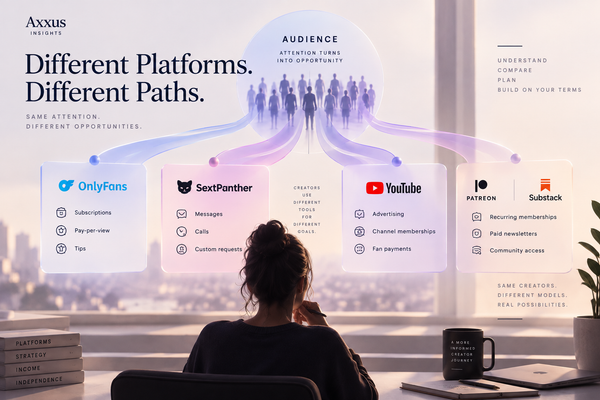
Social and video platforms are built around discovery. Their recommendation systems can put your work in front of strangers, which is why they are where many creators build an audience. Income there is often indirect: a share of advertising revenue, sponsorships you negotiate yourself, or sending people to something you sell elsewhere. Platforms also set their own eligibility rules. YouTube, for example, publishes minimum subscriber and viewing thresholds before a channel can join its Partner Program. The pattern to notice is that attention arrives first, and income only starts once you meet terms someone else wrote.
Subscription platforms
On subscription platforms, fans pay a recurring fee for access to a creator’s content or community. Patreon, Substack and OnlyFans all work on some version of this idea. The economics are different from social media. A smaller, committed audience can support a creator, and the important numbers shift from views to retention, meaning how many subscribers stay month to month. The work shifts too, because subscribers expect regular value in return for the recurring payment.
Messaging and interaction platforms
Some platforms are organised around direct, one-to-one contact. Fans pay for individual interactions such as messages, calls or requests, instead of a flat subscription. SextPanther is an example in the adult creator space; its own site describes fans exchanging direct, voice and video messages with creators. Income on this model follows time and responsiveness. That can suit people who like conversation and dislike producing large volumes of content, and it can be draining for people who do not.
Owned channels
Finally there are channels you control: an email list, your own website, your own storefront. They take longer to grow and put more administration on your plate, including payments, hosting and taxes. What you get in return is independence from any single platform’s rules. Many established creators use platforms for discovery and owned channels for durability.
Most working creators combine several of these. Very few rely on only one.
Free content, paid content, and the space between
Almost every creator business has to answer a simple question: what do I give away, and what do I charge for? Free content brings people in. Paid content is what earns revenue. The balance between them is a strategic choice, and it is also a personal one.
Give away too little, and people never find you or never learn whether they like your work. Give away too much, and there is little reason to pay. Common patterns include free previews on a social platform that point to a paid space, tiered access at different price points, and pay-per-item purchases for specific pieces of content. None of these is correct in general. The right answer depends on your goals, your niche, and the limits you set for yourself.
What people commonly get wrong about audiences
A few assumptions cause a lot of disappointment.
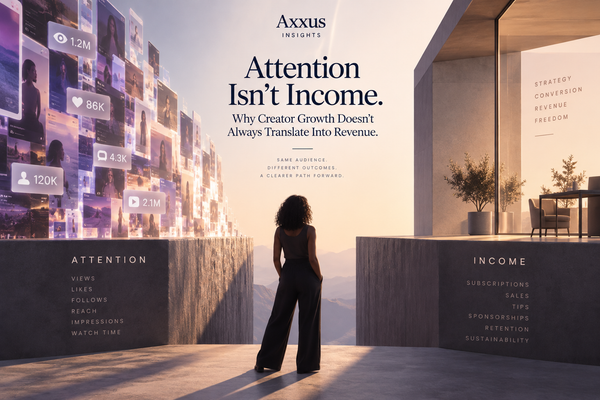
- Followers are not customers. In most cases only a small fraction of an audience ever pays for anything, and that fraction varies widely by niche, platform and offer. Be cautious with any confident claim about a “typical” conversion rate. Attention Isn’t Income covers this gap in more depth.
- Growth is uneven. A post that spreads widely does not guarantee the next one will, and a spike in attention often fades faster than it arrived.
- The audience is not entirely yours. On most platforms, the service controls how far your work travels, what is allowed, and whether your account stays active. Being able to reach your audience by another route, such as an email list, matters more than most beginners expect.
- Bigger is not always better. A few hundred people who value your work can be a healthier base than a much larger audience that scrolls past it.
The workload nobody sees
Making the content is only one part of the job, and often not the largest. Creator work commonly includes:
- Planning, filming or writing, editing and publishing on a schedule
- Answering messages and managing a community
- Handling customer questions, refunds and payment disputes
- Promoting your work across the places where your audience actually spends time
- Checking analytics in several dashboards, each with its own definitions
- Bookkeeping, tracking expenses and preparing for taxes
- Keeping up with changes to platform rules and policies
Two things follow from this. The hours are often irregular, and payment tends to lag behind the work. Something you make this week may only earn money next month, or not at all.
On taxes, in many countries income from online platforms is taxable whether or not a platform sends you a form, and creators are frequently treated as self-employed. The rules depend on where you live. This is general information, not tax advice, and it is worth speaking to a qualified professional early rather than late.
Privacy is a decision you make at the start
Creators choose very different levels of visibility. Some use their real name and face. Some use a pseudonym. Some stay entirely faceless, showing their work but not themselves. All of these are legitimate choices, and they are easier to make well before you post than after.
One point surprises many newcomers. A public pseudonym does not mean the platform does not know who you are. Many platforms require government-issued identification, and sometimes tax or bank details, before they will pay you, and that information sits with the platform and its payment partners even if your audience never sees it. Public identity, platform identity and payment identity are separate layers, covered in How Private Can You Actually Be as a Creator?
It is also worth remembering that anything published online can be copied, saved or shared beyond your control. Decide in advance what you would be comfortable seeing persist for years.
Boundaries are part of the business plan
Boundaries are easy to treat as something you will sort out later. In practice they are a working part of how a creator business runs. Before you start, it helps to know:
- What you will and will not create or discuss, whatever the offer
- How you will respond to requests that fall outside those limits
- When you are available, and how you will protect time off
- How you will handle harassment, pressure or people who push past your limits
- What personal details you will never share
Writing these down in advance makes them easier to hold when someone is pushing on them. It also keeps the work sustainable, because a business that depends on you ignoring your own limits does not last.
Income is uncertain, and that is normal
Creator income is variable by nature. It can rise and fall with platform changes, seasons, algorithm shifts and your own capacity to work. For context, a 2023 Goldman Sachs Research analysis estimated that only about 4% of the world’s roughly 50 million creators could be considered professionals, meaning they earn more than $100,000 a year. That is one estimate from one source, and definitions of “creator” vary, but it is consistent with the general caution that making a full-time living from this work is possible and uncommon.
Practically, this suggests treating early creator income as unpredictable, keeping a financial cushion, avoiding decisions that depend on a particular month’s earnings, and not leaving stable income on the strength of a good week.
Choosing a platform based on what you want
Rather than asking which platform is best, ask what you are trying to build. A rough guide:
- Reach new people: social and video platforms, with the caveat that income comes later and depends on their rules.
- Recurring revenue from a committed audience: subscription platforms.
- Direct, time-based interaction with fans: messaging and interaction platforms.
- Long-term control: owned channels such as a website and an email list, usually alongside one of the above.
- Limited public exposure: check what each platform requires for verification and payment before you commit, and read the details rather than assuming.
Whatever you choose, ask each platform the same practical questions. How and when do I get paid? What share does the platform keep? What identity and tax information do I need to provide? What can the platform do to my account, and how do I appeal? Can I take my audience’s contact details with me if I leave? Rules on all of these change, so check the current terms rather than relying on a review from last year.
A short checklist before you begin
- What is my goal: a side income, a full-time business, a creative outlet, or something else?
- How visible am I willing to be, and what will I never share?
- What are my boundaries, and have I written them down?
- How many hours a week can I realistically give, including messages and admin?
- What financial cushion do I have if income is slow or uneven?
- Which platform terms have I actually read?
- Do I have a way to reach my audience if a platform changes or closes my account?
None of these questions requires an answer today. They are worth asking before your first post, because they are much harder to fix afterwards.
Axxus is creator business infrastructure built to help creators start, grow, and manage their businesses with greater clarity. Learn more at axxus.io.